
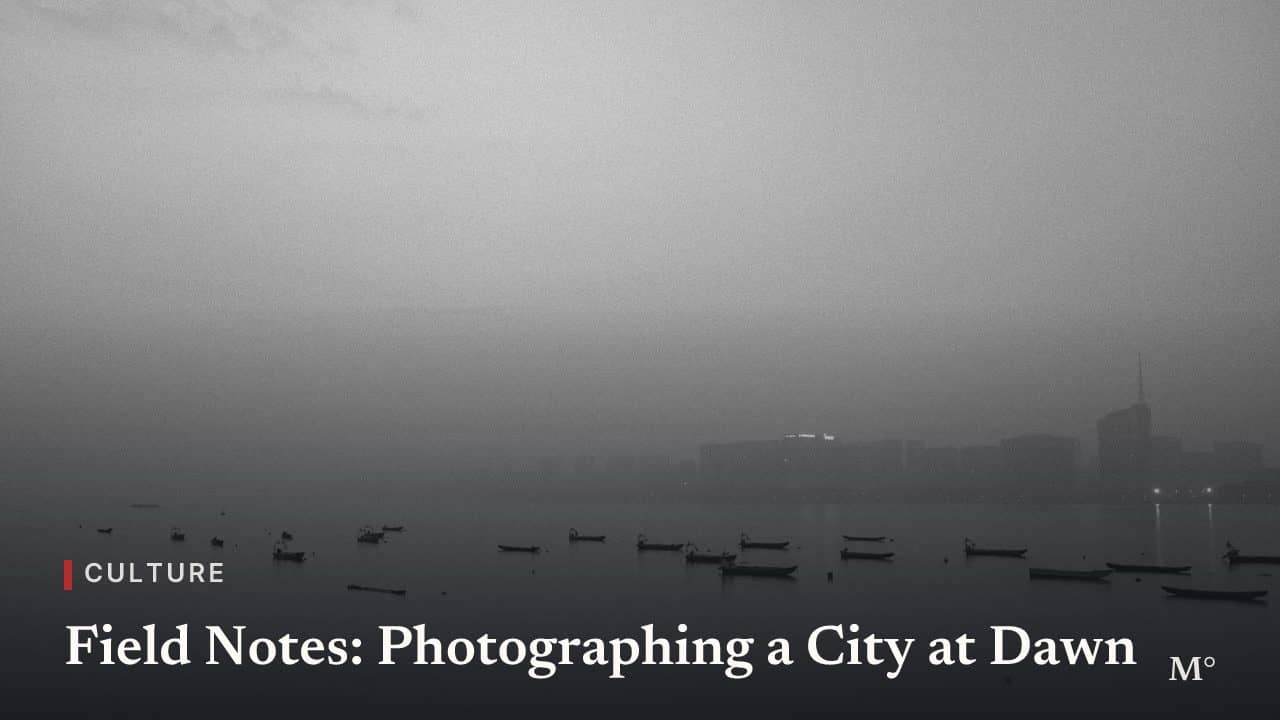
Field Notes: Photographing a City at Dawn
A narrow window of light, a near-empty city, and a small tradition of photographers who show up for it anyway. Notes on what actually happens between night and morning.

Contents
Most of a city's daily rhythm is designed around daylight hours that photographers rarely have entirely to themselves. Dawn is the exception, a narrow, reliably repeating window when a city is at its emptiest and its light at its most forgiving, and a small, dedicated tradition of photographers has built entire practices around showing up for it.
Why the light matters more than the emptiness
The appeal of dawn photography is often described in terms of solitude, empty streets, no crowds to work around, but photographers who shoot consistently at that hour tend to emphasize something else: the quality of the light itself. In the period just before and after sunrise, sunlight travels through more of the atmosphere at a low angle, scattering the harsher blue wavelengths and leaving a warmer, softer light that falls at an angle flattering to architecture and faces alike, without the harsh, high-contrast shadows that midday sun produces. This window, often called the golden hour by photographers generally, is shorter and more variable in a dense urban environment, where surrounding buildings can block direct light entirely for some streets while flooding others.
What actually happens during the shift from night to day
A city at dawn moves through several distinct phases in a short span of time, each with a different character. In the deepest blue hour, before the sun is visible at all, artificial light, streetlamps, illuminated signage, the glow from an early-opening shop, dominates the scene, creating a mixed-light palette that disappears entirely once the sun rises. As the sky brightens, there's a brief period where ambient and artificial light balance closely enough to expose for both simultaneously, a narrow technical window many photographers consider the most valuable few minutes of the entire session. Once the sun clears the horizon, the character of the light shifts again, warmer and more directional, and the dawn quality of the image gives way to ordinary early-morning light within perhaps twenty minutes.
The whole session is a handful of minutes, repeated. Most of the discipline is simply being there, again, for the version of the light that didn't happen to show up last time.
Who is actually out there
The population of a city at dawn is a distinct cross-section, rarely overlapping with daytime crowds: delivery drivers restocking shops before opening, transit and sanitation workers partway through an overnight shift, early commuters, and a smaller number of residents out deliberately for the quiet, runners, dog walkers, and photographers among them. This population gives dawn photography a documentary quality distinct from typical street photography, since the subjects are, almost by definition, people whose relationship to the city operates on a different clock than the one most residents keep.
Practical realities of the practice
The discipline required is more logistical than technical. Sunrise times shift throughout the year, sometimes by hours between seasons, requiring photographers to track them closely rather than relying on habit. Weather is unpredictable enough that a clear forecast the night before offers no guarantee, and a session can be entirely lost to unexpected cloud cover with no warning. Many photographers who shoot dawn consistently describe a high ratio of unproductive mornings to genuinely good ones, treating the practice less as a reliable production method and more as a recurring appointment kept regardless of whether that day's version of the light delivers.
Low light at dawn typically requires either a tripod or a camera capable of clean performance at higher sensitivity settings, since handheld shots risk blur at the shutter speeds the available light demands.
Reflective surfaces, glass facades, wet pavement, still water, become especially valuable at dawn, doubling the limited available light across a frame.
Many dedicated dawn photographers scout locations in advance, in full daylight, specifically to know where to stand before the light arrives, since there is rarely time to find a good composition during the window itself.
A discipline built on repetition
What separates a documented practice of dawn photography from an occasional early start is the repetition: showing up on ordinary mornings, not just the ones with an unusually promising forecast, because the best frame often comes from a session that looked entirely unremarkable in its first few minutes. The city photographed at dawn is, in a sense, a slightly different city than the one most residents ever see, quieter, differently lit, and populated by a shift of people whose day is already well underway before most of the city's has begun.