
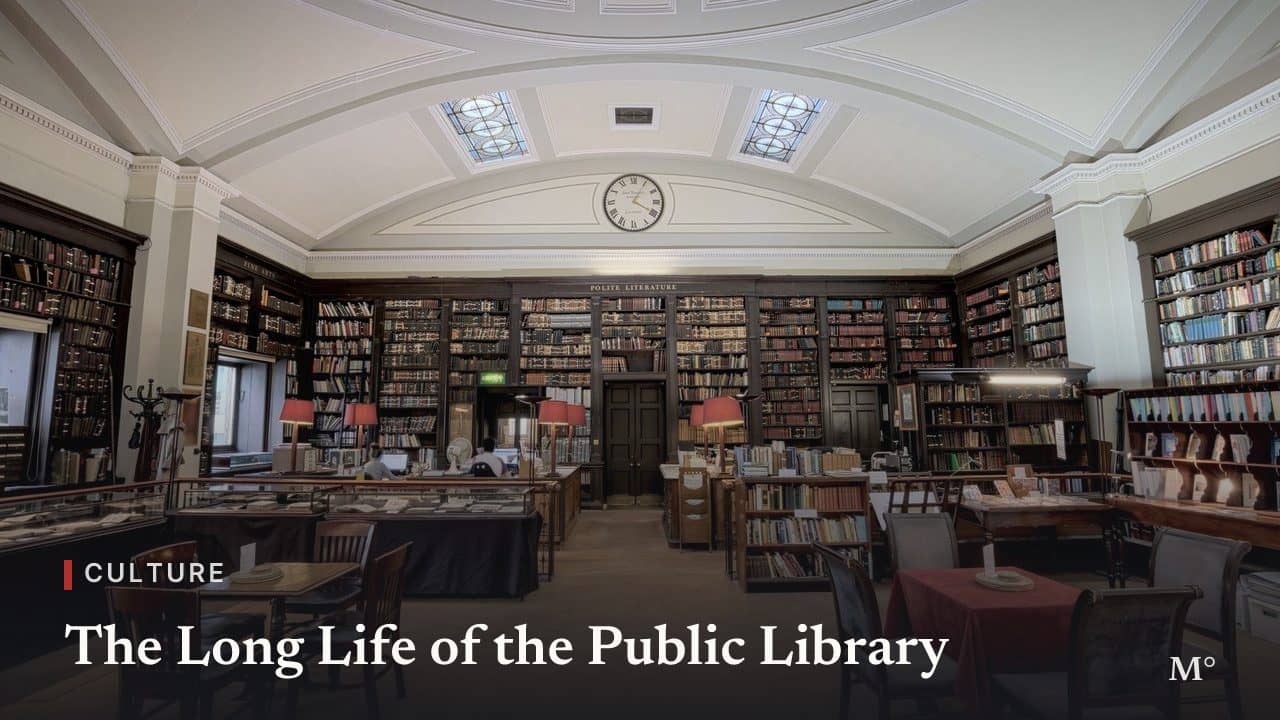
The Long Life of the Public Library
Predictions of the public library's demise have circulated for decades. How the institution quietly absorbed new roles instead, and why circulation numbers only tell part of the story.

Contents
Predictions of the public library's demise have circulated for decades, each new technology cited as the one that would finally make it obsolete. The institution has, so far, done something stranger than survive: it has quietly expanded what it does, until the book collection is only one of several reasons people walk through the door.
An institution that keeps absorbing new functions
The core mission of a public library, free access to information and reading material, regardless of ability to pay, has stayed constant since the institution's modern form took shape. What has changed dramatically is everything built around that mission. A contemporary branch library commonly houses public computers and internet access, meeting rooms available for community use, programming for children and adults, and, in a growing number of systems, tool libraries, seed libraries, or equipment loans that have nothing to do with reading at all. Each addition responded to a specific, identifiable gap: something the community needed and had no other free, unconditional place to get.
This pattern of absorption is easy to miss because it happened gradually, one small program at a time, rather than through any single dramatic reinvention. But it explains why library usage has proven more resilient than a narrow reading of the library as simply a book-lending service would predict.
The unconditional part matters more than it sounds
What distinguishes a public library from most other public buildings is not just that it is free, but that it is free without qualification: no purchase required to stay, no time limit enforced the way a café might informally expect turnover, no requirement to demonstrate need the way some social services do. A person can sit in a library for an entire afternoon and use none of its collection, and this is treated as an entirely legitimate use of the space.
A library is one of the last public places designed for you to simply be there, with no transaction expected in exchange.
This unconditional quality has quietly made libraries a default option for needs the institution was never explicitly designed to meet: a warm or air-conditioned space during extreme weather, a quiet place to study without paying for a coffee, a reliable internet connection for someone without one at home, a safe public space for young people after school. Librarians and library administrators have increasingly had to reckon with this expanded, informal role, sometimes adding staff training or partnerships with social services to meet needs the original architecture of the institution did not anticipate.
Circulation numbers tell only part of the story
Measuring a library's usage purely by items checked out increasingly understates its actual role in a community. Program attendance, computer and wifi sessions, meeting room bookings, and simple foot traffic have become, in many systems, a larger share of overall usage than book circulation, even as circulation itself has remained substantial. Library systems that have adapted their internal metrics to capture this broader picture tend to make a stronger case for continued public funding than those still measuring success primarily by books checked out, since the latter can make a thriving, heavily used library look, on paper, like it is declining.
Funding and the case for keeping it public
Public libraries are funded, almost everywhere, through a mix of local government budgets, and often a dedicated tax levy that voters periodically renew or reject directly. This funding structure means a library's future is, more than most public institutions, subject to a direct and recurring public vote of confidence, which makes the broad, ongoing expansion of library usage described above a genuinely important argument in its own budget debates.
Interlibrary loan systems let a relatively small local collection function as a window into a much larger regional or national one.
Digital lending of e-books and audiobooks has grown quickly, though licensing costs for digital titles are often significantly higher for libraries than for individual consumers, a persistent budget pressure.
Library programming for early childhood literacy is frequently cited by librarians as one of the highest-value, best-evidenced uses of library funding.
A quiet kind of durability
The public library's survival has never depended on resisting change; it has depended on absorbing it, one modest addition at a time, without ever abandoning the original, unconditional promise that made the institution worth having in the first place. That combination, constant adaptation built on a fixed, simple premise, is a large part of why an institution repeatedly declared obsolete keeps finding a new generation that needs exactly what it offers.