
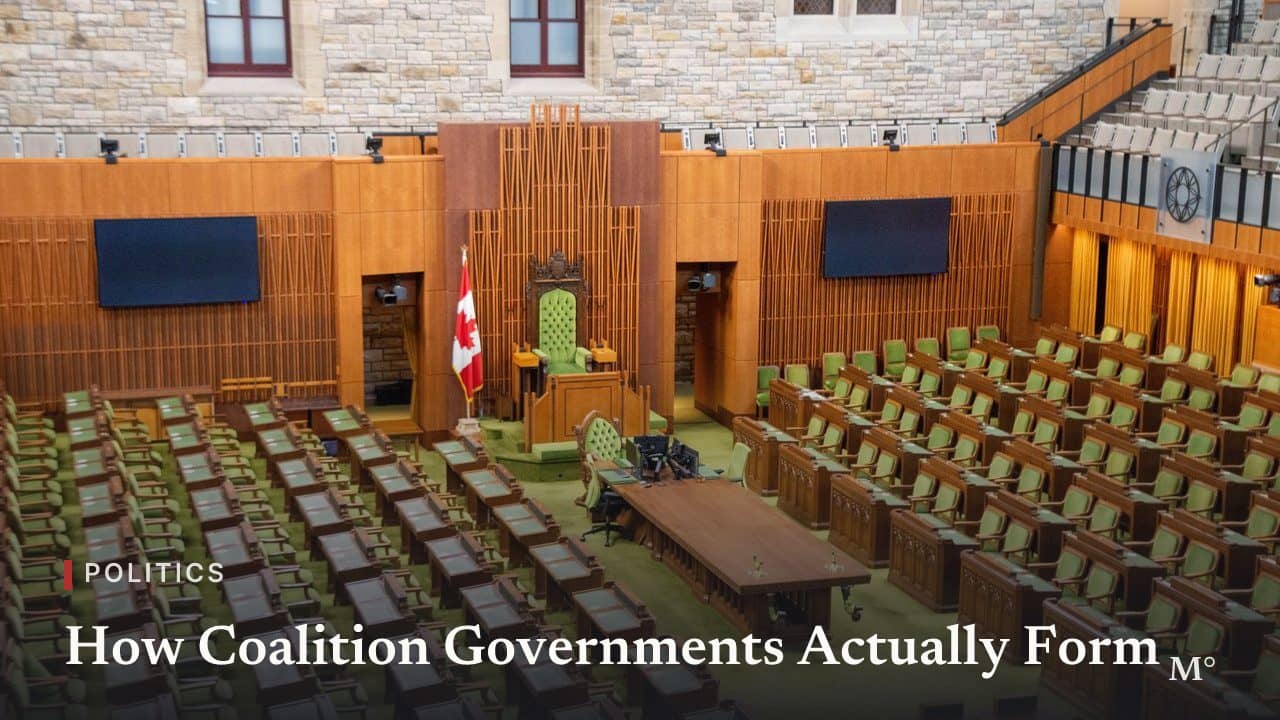
How Coalition Governments Actually Form
Weeks of talks, a thick agreement nobody reads, and a cabinet photo. What happens between election night and the first day of government.

Contents
Election night ends with percentages. Government begins weeks later, with signatures. What happens in between is one of the least understood routines in parliamentary politics: coalition formation.
The arithmetic comes first
Before any policy is discussed, party negotiators do something closer to accounting than politics. A working majority is not simply half the seats plus one — it is half the seats plus one on every vote that matters, including the ones where backbenchers waver, abstain, or trade a vote for a concession back home. Negotiators build a spreadsheet of likely defections before they build a policy program, because a coalition that cannot survive its first confidence vote is not a coalition at all.
This is why the largest party does not automatically lead the talks. In many systems, the head of state invites whichever leader looks most likely to assemble a durable majority — sometimes the second-largest party, if its combination of partners is simpler than the front-runner's. Simplicity matters more than size. A two-party coalition with clean, overlapping interests tends to outlast a three-party arrangement stitched together from ideological opposites, even if the latter commands more seats.
What the talks are actually about
Popular accounts of coalition talks focus on marquee disputes — tax rates, a contested ministry, a symbolic policy pledge. In the negotiating room, most of the time goes elsewhere: to the allocation of ministries nobody profiles, to the wording of dispute-resolution clauses, and to what happens if a partner wants to vote against the government on a single issue without collapsing the whole arrangement.
That last point deserves attention, because it is where most coalition agreements actually live. Modern coalition contracts are not manifestos; they are conflict-management documents. A typical clause might allow a junior partner to abstain on a piece of legislation it dislikes, so long as it does not vote against the government outright and does not treat the abstention as grounds to walk. Reporters rarely quote these clauses because they are dull. They are also the reason coalitions survive votes that, on paper, should have broken them.
A coalition agreement is not a promise about what a government will do. It is a plan for what happens when its partners disagree.
Portfolios as leverage
Ministry allocation follows a predictable pattern once you know what to look for. The largest partner typically keeps the head of government and the ministries with the biggest budgets — finance, and often foreign affairs. Smaller partners trade breadth for depth: rather than spreading thin across several departments, a junior party will often concentrate its ministers in two or three portfolios where it can point to concrete results before the next election. A regional party, for instance, might trade away a shot at a marquee ministry for guaranteed control of infrastructure spending in the areas where its voters live.
This is also where junior partners extract their price for joining at all. A smaller party that delivers a majority a larger one could not reach alone knows its leverage is highest before signatures are exchanged and drops sharply afterward — so a disproportionate share of concessions, measured against vote share, tends to be locked in during the final week of talks rather than negotiated gradually.
The parts that never make the press release
Two features of coalition formation rarely surface in coverage but shape everything that follows. The first is the "exit clause" — the conditions under which a partner can leave the government without triggering new elections, often tied to a formal notice period and a commitment to support the budget already passed. The second is the review point: many coalition agreements schedule a formal renegotiation at the midpoint of the term, giving partners a scheduled off-ramp to recalibrate the agreement against changed circumstances rather than letting friction build until it becomes a crisis.
Neither feature is glamorous. Both explain why some coalitions that look fragile on paper govern for a full term, while others with comfortable majorities collapse within a year. The difference is rarely ideological distance. It is whether the partners built, in those first weeks of quiet arithmetic, a structure that could absorb disagreement without breaking.
Why it matters beyond the cabinet photo
For voters, the coalition agreement functions as a second manifesto — one negotiated after the ballots are counted rather than before, and one that often matters more for what actually gets legislated. Understanding how it was built, and which clauses were fought over line by line, explains far more about a government's next few years than the campaign speeches that preceded it. The cabinet photo marks the end of the process. The document nobody reads is where the government was actually decided.