
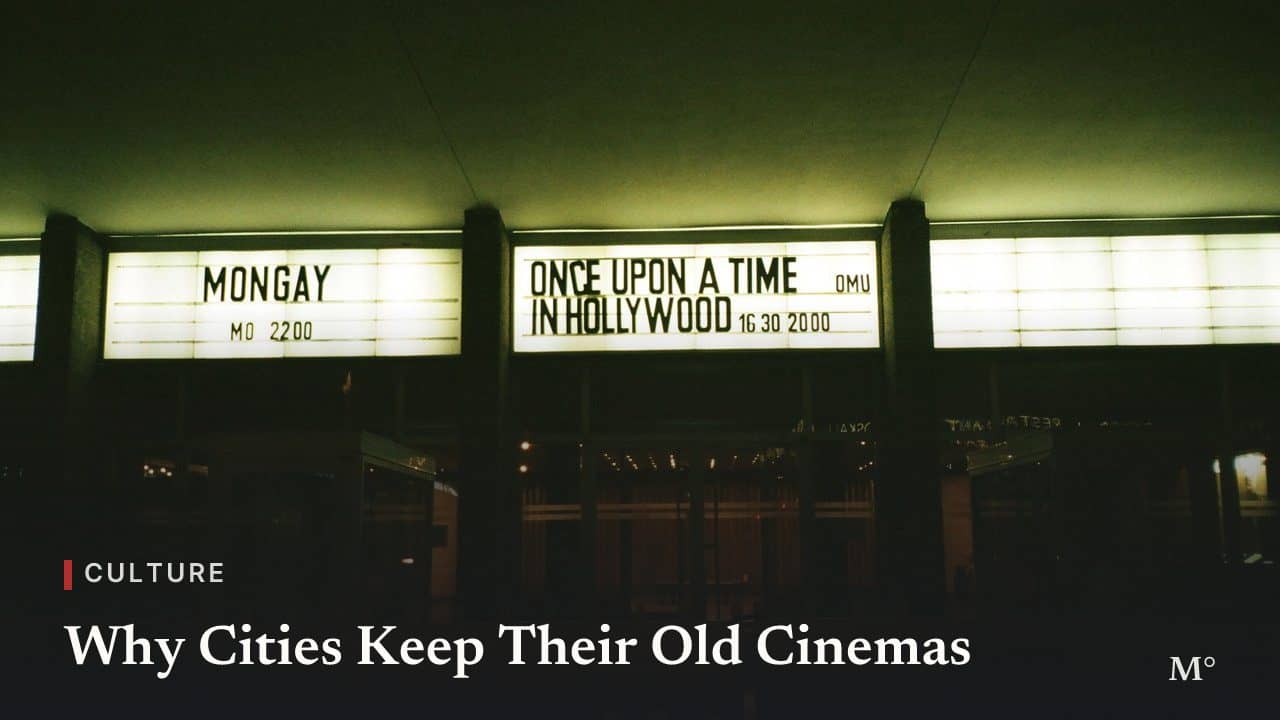
Why Cities Keep Their Old Cinemas
Old cinemas resist easy redevelopment, and that's part of why so many survive. A look at what replaces the box office once the multiplex era moves on.

Contents
In almost every city with a downtown built before the multiplex era, there is at least one old cinema that has refused to disappear, closed, reopened, repurposed, argued over, and somehow still standing while the shops around it turn over every few years. The persistence of these buildings says less about nostalgia than about the peculiar architectural and civic role a cinema plays once it stops being just a place to watch a film.
A building built for one job, badly suited to most others
Old cinemas were built with a single, dominant purpose: a large, dark, uninterrupted volume of space, oriented toward a screen, with sightlines and acoustics engineered for exactly that function. This is precisely what makes them so difficult to convert into anything else. A cinema's core auditorium resists subdivision into offices or apartments far more stubbornly than an old factory or warehouse, where an open floor plate can be partitioned relatively easily. The building's greatest asset, that vast, singular room, is also its biggest liability for any developer looking to repurpose it for conventional use.
This mismatch has an odd upside: it keeps a lot of these buildings surviving in something close to their original form, simply because converting them fully would cost more than it's worth, while demolishing a building with genuine architectural character and civic memory attached to it tends to draw organized local resistance that a nondescript office block never would.
What replaces the box office
Where an old cinema does survive, the most common paths are not a straightforward return to first-run film. Live performance venues, music, comedy, theater, are a natural fit, since the same acoustics and sightlines built for film transfer reasonably well to a stage. Independent and art-house cinema, often run as a nonprofit or community trust rather than a commercial operation, is another common outcome, appealing to an audience that specifically wants an alternative to the multiplex experience. A smaller number become multi-purpose community spaces, hosting everything from film screenings to civic meetings to markets, particularly in neighborhoods where few other large indoor public spaces exist.
The economics of keeping the lights on
None of these paths are especially profitable in the way a commercial multiplex chain is. Restored cinemas typically survive through a patchwork: ticket revenue, venue rental for private events, grants tied to historic preservation, and, very often, a nonprofit trust or a dedicated group of local volunteers willing to do the unglamorous work of fundraising and maintenance that keeps an aging building operational. The buildings that make it are usually the ones where a committed local constituency decided, explicitly, that losing the cinema would cost the neighborhood something a parking lot or a chain store could not replace.
A cinema rarely survives because it is profitable. It survives because enough people in a neighborhood decided it was worth the trouble.
Architecture as civic memory
Beyond function, an old cinema often carries a density of local memory that newer buildings simply have not had time to accumulate, generations of a town's residents who had a first date, a childhood matinee, or a community meeting in the same room. This is part of why campaigns to save a threatened cinema tend to draw support well beyond the people who would actually attend a screening there regularly. The building functions as a kind of shared civic landmark, and its facade, often one of the more ornate on a given street, built in an era when a cinema was meant to feel like an occasion, becomes a piece of streetscape people notice missing long after they stopped noticing it was there.
Art deco and other ornate architectural styles common to early- and mid-century cinemas make many of these buildings eligible for historic protections unavailable to plainer commercial structures.
Adaptive reuse projects for old cinemas are frequently among the more heavily subsidized small-scale preservation efforts a city undertakes, reflecting how much public sentiment tends to favor saving them.
A restored cinema often becomes an anchor for surrounding foot traffic, a fact that has made some downtown revitalization plans build explicitly around saving one rather than treating it as a side project.
Why it keeps happening
City after city repeats roughly the same story: a beloved old cinema faces closure, a local campaign forms, and, more often than pure economics would predict, the building survives in some new form. The pattern holds not because the economics have changed, but because the value a cinema provides was never purely economic to begin with.